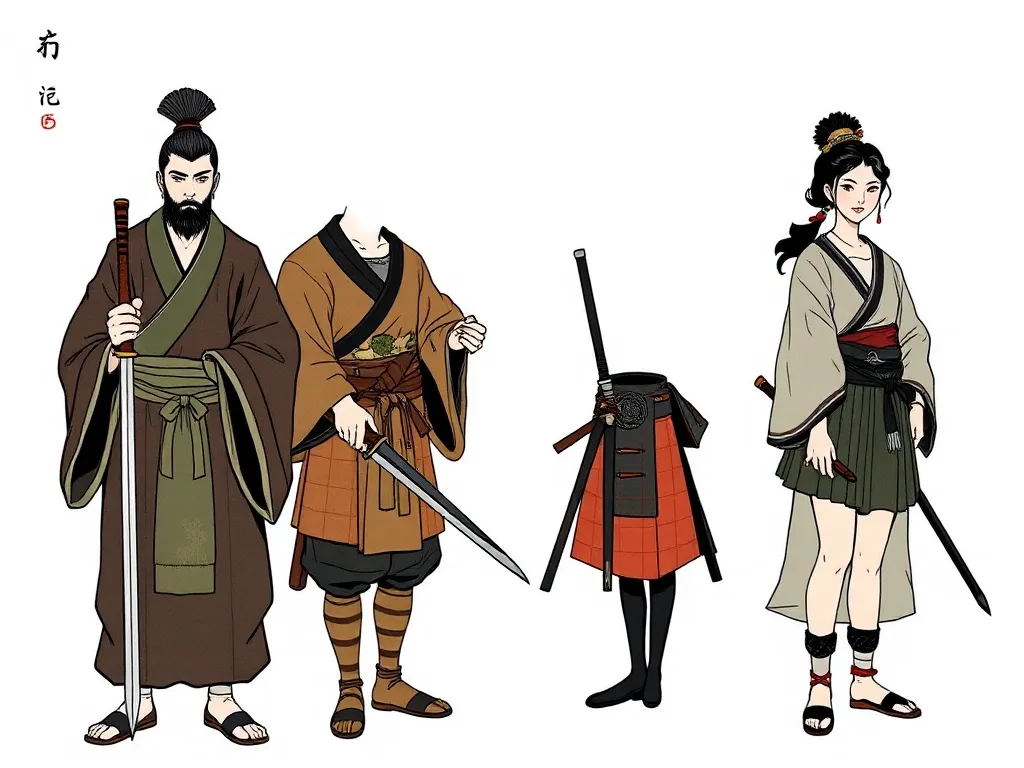
Prompt:
CLEAN ROOM — INDEPENDENT GENERATION: Treat every generation as a new, unrelated illustration; preserve only this rendering style and do not reuse or approximate previous faces, bodies, compositions, costume/equipment layouts, environments, palettes, or motifs. STYLE: clean, crisp, moderately detailed medieval-fantasy illustration resembling restrained Western pen-and-ink art translated into a carefully carved, freshly pulled historical woodblock print; precise organic dark ink with light-to-moderate line-weight variation, medium-low/medium line density, strong readable silhouettes, selective contour strokes and restrained hatching, large quiet areas, and no unnecessary surface noise. CHARACTERS: make every individual visibly distinct; when unspecified naturally vary skull/face shape, jaw, chin, cheekbones, nose, brow, eyes, mouth, ears, hairline/style/texture, facial hair, age, height, build, proportions, and subtle asymmetry; avoid recurring handsome angular faces, heroic physiques, or generic protagonist templates; use naturalistic anatomy and believable hands. POSE: for ordinary single-character subjects, default to a conventional polished fantasy character-art pose: stable, composed, balanced, and naturally posed for viewing, usually standing at rest or holding equipment in a comfortable deliberate manner; avoid awkward mid-step poses, lifted feet, frozen walking animations, exaggerated contrapposto, theatrical gestures, or unnecessary action. Do not create motion merely because the description says a character “walks with,” “carries,” “uses,” or “wields” an item; treat those as equipment/character details unless active movement is explicitly requested. If the SUBJECT clearly describes combat, riding, running, working, interacting, or another action, use a strong readable pose appropriate to that action. COSTUME/EQUIPMENT: follow the subject closely; keep designs functional and archetypal unless ornament is requested; do not automatically add recurring straps, pouches, talismans, necklaces, feathers, trophies, decorative knives, elaborate buckles, wraps, layered embellishment, or fantasy clutter. COLOR: use roughly 3–5 principal hues plus ink and paper tone, favor muted/moderately desaturated historical pigments such as browns, olives, creams, charcoal, gray-browns, ochres, muted rust, faded blue-gray, and restrained burgundy while allowing explicitly requested strong colors as controlled accents; use clean semi-flat printed color regions with subtle tonal variation, never muddy, scratched, mottled, glossy, airbrushed, painterly, or cinematic. SHADING: use coherent natural lighting and broad clean graphic shadow masses like additional printed color regions—clean light plane → muted shadow plane → selective ink accents—with sparse hatching only as reinforcement; avoid dense crosshatching, granular noise, muddy blacks, scratch-based shading, dramatic chiaroscuro, bloom, rim lighting, or volumetric effects. MATERIALS: distinguish through shape and selective marks rather than heavy texture—hair/fur as grouped masses with limited directional strokes, cloth as broad folds and clean shadows, leather as seams and restrained creasing, metal as clear light/midtone/shadow planes with sparse ink accents and no unnecessary corrosion, wood with minimal grain, stone/terrain/architecture with simplified planes and selective texture. PRINT QUALITY: clean, well-preserved, freshly pulled woodblock print with solid deliberate ink, slight ink irregularity, subtle pigment variation, understated warm-ivory/light-cream paper grain, and minimal printing imperfections; no dirt, foxing, abrasion, grime, stains, cracked pigment, severe fading, distressed parchment, random scratches/speckles, or artificial aging. COMPOSITION/ENVIRONMENT: let the SUBJECT determine framing and scene content; unless the subject explicitly requests an isolated figure, plain/blank background, character sheet, or no environment, include a contextually appropriate background; backgrounds should establish place without overwhelming the subject, using simpler shapes, lower line density, fewer small details, and quieter colors; if the subject specifies a scene or environment, depict it faithfully; create depth through overlap, reduced background detail, simplified color, and tonal separation rather than blur. AVOID ornate fantasy splash art, ultra-detailed concept art, anime/manga, modern comic-book rendering, flat vector art, painterly digital fantasy, photorealism, exaggerated Japanese subject matter unless requested, overly thick outlines, excessive hatching, accessory clutter, dense strand-by-strand hair/fur, repetitive faces/costumes, awkward transitional poses, dirty pigments, filthy cloth, granular shadow noise, and heavily distressed printing. VISUAL PRIORITY: distinct individuals → polished readable character-art presentation → strong silhouette → restrained precise ink drawing → clean graphic shadow masses → limited semi-flat color → contextual but subordinate environment → subtle handmade print texture. SUBJECT: A hulking bald man with a black beard and mail armor, wielding a fishing hook
Generated with the Ukiyo - e AI Generator | Promptus AI model on Promptus. Try a prompt of your own.